

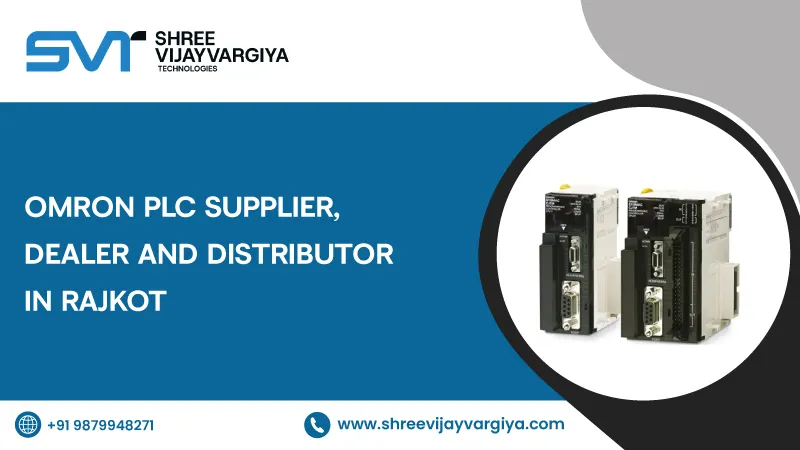
In Morbi, a production line rarely gets a quiet day. A tile plant keeps its roller kiln fired for weeks at a stretch, and every machine upstream and downstream has to keep pace with it: the press that forms the biscuit, the glaze line that dresses it, the digital printer that adds the design and the sorting line that grades it before packing. Behind almost each of these machines is a control panel, and inside that panel a PLC decides what moves, when it moves and what happens when something goes wrong. When that controller is poorly chosen or hard to replace, the whole chain feels it.
Shree Vijayvargiya Technologies Pvt. Ltd. (SVT) has its own office and warehouse in Morbi, on NH-8A at Trajpar, opposite Kuber Cinema. Ceramic plants, machine builders and panel makers in the town can walk in, call or send their requirement, and we help them pick the right Omron controller, the matching I/O and communication modules, and the accessories that complete the panel. This page explains how PLCs are used in Morbi's industries, what the local conditions demand from a control panel, and how to approach selection, upgrades and spares.
Why PLC Control Matters in Morbi's Ceramic Cluster
Morbi grew from a small princely town on the Machchhu river into the country's best-known centre for ceramic tiles and sanitaryware. Today the cluster takes in wall and floor tile units, vitrified and large-format slab plants, sanitaryware factories, glaze and frit makers, and a long list of local fabricators who build conveyors, glaze lines, stackers and packing machines for these plants. The industrial spread continues along the highway towards Wankaner, where more tile and allied units have come up.
What sets Morbi apart from a typical engineering town is the nature of the process. A ceramic line is a continuous, linked process with a kiln at its centre. The kiln cannot be switched off and restarted casually, so everything feeding it must be dependable. PLC control gives that line a repeatable sequence, clear interlocks between sections, and alarms that tell the maintenance team exactly which station has stopped. Many local machine builders also use PLCs to make their equipment easier to commission and service across dozens of customer plants.
Where an Omron PLC Fits Along a Tile Line
- Raw material and body preparation: weigh feeders and batching for ball mill charging, ball mill run-time and rotation logic, slip transfer pumps, agitators in slip tanks and the sieving and iron removal stages.
- Spray dryer section: sequencing of the hot air generator, atomising pump, exhaust fan and cyclone or bag-filter cleaning, with interlocks so that slip is not sprayed before the chamber is at temperature.
- Powder handling: silo level monitoring, bucket elevators, belt conveyors and the feeding system to the press hoppers.
- Press and dryer area: the hydraulic press often comes with its own controller, but the tile take-off, turnover, brushing and transfer to the vertical or horizontal dryer are commonly PLC-based.
- Glazing and decoration: glaze line conveyors, bell or airless glaze application, engobe stations, tile counting, gap control and the hand-off to the digital inkjet printer.
- Kiln entry and exit: loading and unloading tables, storage boxes (box loaders) that buffer tiles when a downstream section stops, and roller conveyor drives.
- Sorting, packing and palletising: shade and size grading stations, stacking, box forming, strapping, labelling and pallet movement.
- Polishing and finishing for vitrified tiles: calibration and squaring machines, polishing head sequencing and water recirculation pumps.
Large kilns and imported presses usually arrive with their own control systems from the machine maker. Where Omron PLCs are most often specified in Morbi is on the balance of plant around them, on locally built machines, and on retrofit panels that replace old relay logic or obsolete controllers.
Sanitaryware, Clocks and Allied Industries
Sanitaryware plants use PLCs on slip preparation, casting lines, pressure casting machines, glazing booths, dryers and shuttle or tunnel kiln auxiliaries. The process is slower than tile making but just as dependent on correct timing, because casting and drying cycles directly affect cracks and rejection.
Morbi is also known for its wall clock and small consumer goods manufacturing. These units run plastic injection moulding machines, ultrasonic welding, pad printing, assembly conveyors and packing machines. A compact PLC is well suited to counting, indexing and station sequencing on such lines. Packaging suppliers serving the tile trade, such as carton and corrugated box makers, also use PLC control on their converting machines.
Site Conditions a Morbi Control Panel Must Handle
A PLC is built for industrial duty, but the panel around it decides how long it actually survives. Ceramic plants put three kinds of stress on control panels that buyers should plan for from the start.
Fine Dust Everywhere
Body powder, glaze overspray and polishing slurry produce a fine dust that settles on everything. It blocks filter mats, coats the heat-sink fins of drives and power supplies, and builds up on terminals. Over time, dust combined with humidity can create leakage paths between terminals. Keep PLC panels well sealed with proper gaskets and cable glands, use filter fans with a cleaning schedule that is actually followed, and in heavy-dust areas consider a panel air conditioner instead of open ventilation. Mount the PLC panel away from the spray dryer cyclone outlets and the glaze booth wherever the layout allows.
Heat Near Kilns and Dryers
Panels placed beside kilns, spray dryers and hot air generators see ambient temperatures well above a normal shop floor, especially in a Saurashtra summer. Check the operating temperature range of the controller and its I/O units in the Omron datasheet, and remember that the temperature inside a closed panel is higher than the room outside it. Leave space around the PLC for airflow, keep it away from heat-generating drives in the same enclosure, and avoid mounting panels directly on hot walls or structures.
Power Quality and Electrical Noise
A ceramic plant has many AC drives, large fan motors and hydraulic power packs. Drives and switching loads create electrical noise, and voltage dips on the grid can reset poorly protected control circuits. Feed the PLC through a stable 24 V DC power supply of adequate rating, separate control and power wiring, use shielded cable for analog signals such as temperature and pressure transmitters, and earth the shield at one end only. For critical sections such as kiln auxiliaries, a UPS on the control supply helps the PLC ride through short interruptions and record what happened.
Selecting the Right Omron PLC for Your Morbi Application
Omron offers controllers from small compact units to full machine automation platforms. Our Omron PLC page covers the complete range; here is how the main families usually line up against Morbi applications.
Compact Controllers: CP1E, CP2E and CP1H
For a single machine such as a tile turnover unit, a stacker, an agitator group or a packing station, a compact controller is often enough. The CP1E is an economical choice for simple sequencing. The Omron CP2E adds built-in Ethernet on several variants, which is useful when the plant wants to connect machines to an HMI or SCADA, or when a machine builder wants remote access for program changes. The CP1H suits compact machines that need more high-speed counters and pulse outputs, for example indexing or simple positioning.
Modular Controllers: CJ2M
When a line section has a large I/O count, several analog loops or a mix of serial and network communication, a modular CJ2M gives more room. It is common on spray dryer control, body preparation sections and full glaze lines where expansion is likely later. Modular units also make it easier to keep spares, since a single failed I/O card can be swapped without replacing the whole controller.
Machine Automation Controllers: NX1P2, NJ and NX
For machines that combine logic with coordinated motion, such as servo-driven stacking and palletising, box forming or high-speed sorting, the NX1P2 and the NJ/NX range bring EtherCAT motion control, built-in EtherNet/IP and programming to the IEC 61131-3 standard in Sysmac Studio. Machine builders in Morbi who make equipment for many plants can use these platforms to standardise their designs.
A Practical Checklist Before Ordering
- Count digital and analog I/O for the machine, then add spare capacity for sensors you will add later.
- Note the output type needed: relay for mixed loads, transistor for fast switching and pulse outputs.
- List the devices the PLC must talk to: HMI, drives, temperature controllers, weighing indicators or a plant SCADA.
- Decide whether the panel will be near a kiln, dryer or glaze booth, and plan cooling and sealing accordingly.
- If you are replacing an old controller, collect the exact model number, program backup and I/O wiring details first.
- Agree on a programming software version within your team so that backups and edits stay compatible.
Upgrading Older Panels in Running Plants
Many Morbi units were set up in waves over the past few decades, and their older lines still carry relay panels, discontinued PLCs or controllers whose programming cable and software nobody can find. These panels keep running until the day a card fails, and then the plant discovers that the replacement is no longer made.
A planned migration avoids that situation. Start with the sections whose failure would stop the kiln or block its exit, such as kiln loading and unloading, storage boxes and sorting lines. Take a full backup of the existing program, print the I/O list, and photograph the panel wiring before the shutdown. Choose a current Omron model with enough spare I/O, and where possible reuse the existing field wiring by mapping terminals carefully. Schedule the changeover for a planned kiln maintenance stop or a low-production period, and test the new sequence with the line running empty before tiles are sent through.
After the upgrade, store the new program in at least two places away from the machine, and keep a printed copy of the I/O list inside the panel door. This simple habit saves hours when a fault occurs at night.
Planning Spares for Continuous Kiln Operation
A roller kiln runs continuously, so the cost of a controller failure is not just the price of the part. Tiles stuck in a stopped section may be lost, and restarting the line takes time. That is why Morbi plants should treat PLC spares as part of production planning, not as an afterthought.
- Identify the controllers whose failure would stop the kiln or hold up its output, and keep at least one spare CPU of each model used there.
- Keep spare I/O units of the most-used types, a 24 V DC power supply, and a programming cable.
- Standardise on fewer PLC models across the plant so that one spare can cover several machines.
- Record firmware versions and keep the matching program backups with the spare.
- Review the spares list once a year, especially after adding new lines.
If you are unsure which parts to stock, share your panel list with our Morbi office and we can help you build a sensible spares list based on the models installed.
Buying Omron PLC from SVT in Morbi
SVT's Morbi Office & Warehouse is at B-18, Parshwanath Complex-1, Opp. Kuber Cinema, NH-8A, Trajpar, Morbi, Gujarat 363642. Customers from the town, the surrounding ceramic zones and the Wankaner side can visit the office between 9 AM and 6 PM, Monday to Saturday, or call +91 9879948267. Our Ahmedabad office at A-705, Titanium City Center, Prahlad Nagar, Ahmedabad 380015 (+91 9879948273) also handles enquiries and orders.
When you contact us, it helps to share the machine type, the I/O list or the model you are replacing, and any communication requirement. We confirm part numbers, suggest the right accessories, and dispatch from the Morbi warehouse or from Ahmedabad depending on the items. Along with PLCs, we supply Omron HMIs, temperature controllers, sensors, relays, timers and power supplies, so a panel builder can source the full control package from one place. Technical questions during programming and commissioning are handled by our team over phone and email.
SVT also covers other districts across Gujarat; you can see the full list on our service areas page.
Talk to Our Morbi Team
Planning a new line, rebuilding an old panel or building spares for the kiln section? Call our Morbi office on +91 9879948267, our Ahmedabad office on +91 9879948273, or email sales2@shreevijayvargiya.com with your requirement.
Key Takeaways
- Morbi's ceramic lines run continuously around the kiln, so PLC reliability and spares directly affect output.
- Omron PLCs are widely used on body preparation, spray dryer, glazing, kiln handling, sorting and packing sections, and on locally built machines.
- Dust, heat near kilns and dryers, and electrical noise from drives must be handled through panel design, not left to the controller alone.
- CP1E, CP2E and CP1H suit single machines; CJ2M suits larger sections; NX1P2 and NJ/NX suit machines with coordinated motion.
- SVT's Morbi office and warehouse at Trajpar, along with the Ahmedabad office, supports selection, replacements and dispatch.
Frequently Asked Questions
Summarize with AI: