

Ceramic manufacturing is often described in terms of heat: the spray dryer, the dryer and above all the roller kiln. But once a tile leaves the press, much of what happens to it is about motion. It is turned, brushed, glazed, printed, stacked, graded, squared, polished, counted and packed, and the faster and more accurately those movements happen, the less breakage and rework a plant has to absorb. That is where servo systems have become steadily more common across Morbi.
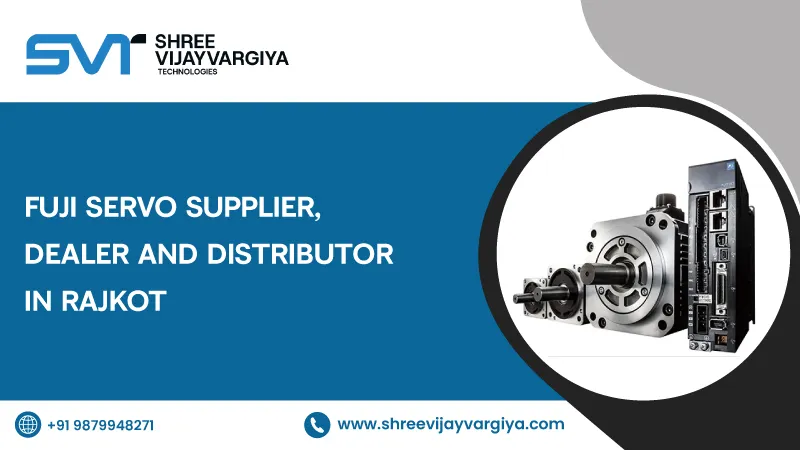
Shree Vijayvargiya Technologies Pvt. Ltd. (SVT) supplies Fuji Electric servo motors and servo amplifiers to ceramic plants, machine builders and automation integrators in Morbi from our office and warehouse at Trajpar on NH-8A. This page looks at where servos are used in the local industry, how working conditions in a tile plant affect servo selection and installation, and what to check before you order a motor and amplifier set or a replacement.
Motion Control in Morbi's Tile and Sanitaryware Plants
Morbi's industrial base is dominated by wall tiles, floor tiles, vitrified tiles, large slabs and sanitaryware, supported by a dense network of local fabricators who build handling and finishing machines for these plants. The belt reaches out along the highway to Wankaner. As tile sizes have grown and buyers have become stricter about edges, flatness and packing quality, many of these machines have moved from cams, clutches and induction motors to servo-driven axes.
A servo gives three things a ceramic machine needs: accurate positioning without mechanical adjustment, smooth acceleration that does not crack a green or fired tile, and the ability to change a recipe when the tile size changes. On a line that handles several sizes in a month, setting a new size from an HMI instead of resetting stops and cams saves a lot of changeover time.
Typical Servo Applications in a Ceramic Plant
- Stacking and de-stacking: lifting and lowering stacks of tiles at kiln entry and exit, storage boxes and sorting lines, where a smooth motion profile protects tile edges.
- Pick-and-place and palletising: gantry or cartesian systems that lift boxes or sorted stacks and place them on pallets, often with two or three coordinated axes.
- Squaring and calibration machines: positioning of grinding heads and adjustment axes on vitrified tile finishing lines.
- Polishing lines: traverse movement of polishing heads across wide tiles, where a consistent speed and dwell time affect surface finish.
- Cutting of large slabs: positioning the cutting carriage or the slab itself for strips, steps and smaller formats cut from large panels.
- Box forming, folding and strapping: packing machines that form cartons, fold flaps and apply straps in step with the tile flow.
- Feeding and indexing: accurate infeed to glaze applicators, decoration stations and inspection points.
Large imported machines such as presses, digital printers and kilns usually arrive with their own motion systems. Fuji servos are more often chosen by local OEMs who design handling, finishing and packing equipment, and by plants that retrofit or improve existing machines.
Wall Clocks, Plastics and Packaging Machines
Morbi's wall clock and small consumer goods makers run injection moulding machines with take-out robots, pad printing, screw fastening, assembly conveyors and blister or carton packing. Servo axes here handle precise indexing and short, quick moves. Corrugated box and packaging converters serving the tile trade use servos on feeders, cutters and printing-slotting sections. In each case, the core requirement is the same: repeatable positioning, quick acceleration and easy parameter changes.
Fuji Servo Families for Morbi Machine Builders
Fuji Electric's servo range is built around the ALPHA series of motors and amplifiers. Our Fuji servo system page covers the range in detail; the overview below shows how the families are usually applied.
ALPHA5 Smart
ALPHA5 Smart systems are found on a large number of existing machines across Gujarat. Many Morbi maintenance teams look after machines built with these units, so it is worth knowing the exact motor and amplifier part numbers on your machines. When a unit needs replacement, we can help you check whether the same model is available or which current model is the suitable alternative, including what needs to change in cabling, mounting or parameters.
ALPHA7
The Fuji ALPHA7 servo system is the current generation, offering higher-resolution encoders, improved responsiveness, auto-tuning and vibration suppression functions that help when a long gantry or a stacker arm tends to oscillate at the end of a move. ALPHA7 amplifiers are available with different command interfaces, including pulse and analog input types and network-interface types, so the same family can suit a simple PLC-controlled axis as well as a multi-axis networked machine. Confirm the interface type with us before ordering, because it decides how the amplifier connects to your controller.
Matching the Servo to the Controller
On a simple machine, a PLC with transistor pulse outputs can command one or two servo axes. For machines with three or more coordinated axes, such as palletisers, a motion controller or a network-based setup is usually cleaner. Before choosing, list how many axes the machine has, whether they must move together, and which PLC or motion controller you already use, so the interface and cabling are matched correctly from the start.
When a Servo Is the Right Choice
Not every moving part of a tile line needs a servo. A long belt conveyor that only has to run at a set speed is better served by an induction motor and an AC drive. A servo earns its cost where an axis must stop at a precise position, change its stroke or speed for different tile sizes, or move in step with another axis. Typical signs that a machine will benefit from servo control are frequent size changes that currently need mechanical resetting, edge chipping caused by harsh starts and stops, worn clutches and brakes on indexing mechanisms, and machines that cannot keep up with a faster kiln. Stepper motors are sometimes used on light, slow axes, but on heavier ceramic loads they can lose steps without any warning to the controller, whereas a servo works in closed loop and raises an alarm if it cannot follow the command. If you are unsure which approach suits a particular machine, describe the motion to our Morbi team and we will help you weigh the options.
Working Conditions That Shape Servo Selection
A servo that performs well on a test bench can still have a short life in a ceramic plant if site conditions are ignored. Four factors deserve attention in Morbi.
Ceramic Dust and Slurry
Dry body powder, glaze mist and polishing slurry find their way into motors, connectors and amplifier panels. Check the protection rating of the motor for the location where it will be mounted, especially on polishing and squaring lines where water and abrasive slurry are present. Use sealed connectors and correctly routed cables with drip loops, and keep amplifiers inside closed panels with clean airflow. Dust on the amplifier heat sink reduces cooling and leads to overheating trips.
Heat Near the Kiln
Stackers and handling systems at the kiln exit work close to hot tiles and warm air. Motor and amplifier ratings assume certain ambient temperatures, and a hot environment reduces the safe continuous load. Choose the motor with enough thermal margin, avoid mounting amplifiers in panels that also hold large heat-generating drives without adequate cooling, and keep cable routes away from hot surfaces.
Load Inertia and Duty Cycle
Tile stacks, box loads and long gantry arms add inertia. If the load inertia is too high compared to the motor's rotor inertia, tuning becomes difficult and the axis may overshoot or vibrate. Calculate the load inertia, the required peak and continuous torque, and the move profile, and use a gearbox or belt reduction where needed to bring the inertia ratio into a comfortable range. For vertical axes such as stack lifters, use a motor with a holding brake and design the sequence so the brake engages before power is removed.
Power Quality and Noise
Ceramic plants have many AC drives and large motors on the same supply. Voltage fluctuations and electrical noise can lead to amplifier alarms or encoder errors. Use proper earthing, keep encoder cables shielded and separate from motor power cables, fit line filters where noise is a problem, and protect the control supply so that a short dip does not reset the system in the middle of a move.
Commissioning Tips for Servo Axes on Tile Lines
- Run auto-tuning with the actual mechanical load connected, not with the motor running free.
- Set software travel limits and hardware limit switches on every linear axis, and test homing at low speed first.
- Use acceleration and deceleration ramps that protect the tile; a jerky stop can chip an edge even if the position is correct.
- Save the final parameter file and keep a copy with the machine documentation and another away from the machine.
- Label each motor and amplifier with its axis name so that the maintenance team can identify it quickly during a breakdown.
Spares Planning Around Continuous Kiln Operation
A servo axis at the kiln exit or on a storage box can hold up the kiln output if it stops. When the downstream line is blocked, tiles have nowhere to go, and the plant may have to slow or stop the kiln. Plants that depend on servo-driven handling should keep critical spares on hand rather than ordering after a failure.
- Keep at least one spare amplifier of each rating used on kiln-critical machines.
- Keep spare encoder and power cables of the correct length and connector type, since cables are a common failure point on moving axes.
- Where several machines use the same motor size, one spare motor can cover them.
- Store parameter backups with the spares so that a replacement can be set up quickly.
- When machines use older ALPHA5 models, discuss the replacement path in advance so you are not searching for compatibility during a breakdown.
Buying Fuji Servo Systems from SVT in Morbi
Our Morbi Office & Warehouse is at B-18, Parshwanath Complex-1, Opp. Kuber Cinema, NH-8A, Trajpar, Morbi, Gujarat 363642, open Monday to Saturday from 9 AM to 6 PM. Ceramic plants, OEMs and panel builders can visit or call +91 9879948267. The Ahmedabad office at A-705, Titanium City Center, Prahlad Nagar, Ahmedabad 380015 (+91 9879948273) also handles enquiries.
To help us suggest the right set, share the machine type, number of axes, load details, required speed and the controller you use. For replacements, the nameplate details of the existing motor and amplifier are the quickest starting point. We confirm part numbers and accessories such as cables and brakes, and dispatch from the Morbi warehouse or Ahmedabad. Our team answers technical questions on selection, wiring and parameter setting by phone and email. We also supply Fuji PLCs, HMIs and AC drives, so a complete motion package can come from one source.
SVT supports customers in many other parts of Gujarat as well; the full list is on our service areas page.
Contact Our Morbi Office
Building a new stacker, upgrading a packing machine or planning servo spares for the kiln exit? Call Morbi on +91 9879948267, Ahmedabad on +91 9879948273, or email sales2@shreevijayvargiya.com.
Key Takeaways
- Servo axes in Morbi handle stacking, palletising, squaring, polishing, slab cutting and packing, where smooth and accurate motion protects tiles.
- Fuji ALPHA7 is the current servo generation, while many existing machines still run ALPHA5 Smart units that need a planned replacement path.
- Dust, slurry, kiln heat, load inertia and power quality all influence motor and amplifier selection.
- Kiln-critical handling machines need spare amplifiers, cables and parameter backups kept ready.
- SVT's Morbi office and warehouse at Trajpar, along with the Ahmedabad office, supports selection, replacement and dispatch.
Frequently Asked Questions
Summarize with AI: