

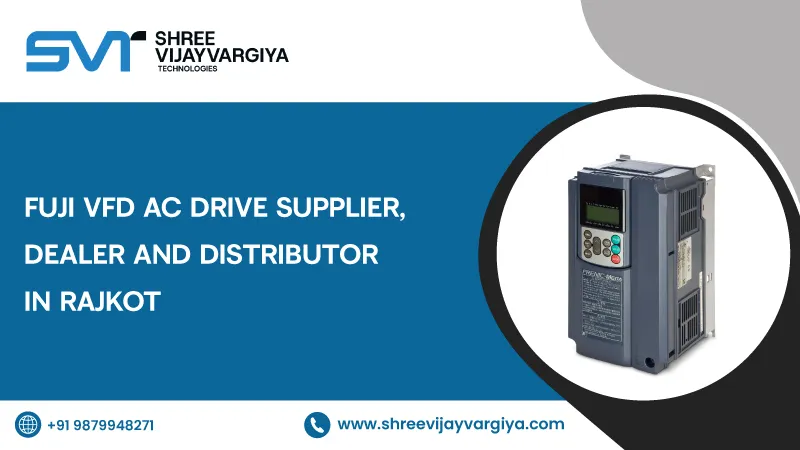
Ask the owner of any tile plant in Morbi about running costs and the conversation quickly turns to fuel and electricity. Ball mills grind for hours, spray dryer fans move huge volumes of hot air, and a roller kiln keeps dozens of fans and roller drives turning around the clock. A large share of that electrical load is motors running at speeds set by dampers, valves or fixed gearing rather than by what the process actually needs. An AC drive, also called a VFD or inverter, lets the motor run at the speed the process asks for, and in a ceramic plant that makes a visible difference to both control and power consumption.
Shree Vijayvargiya Technologies Pvt. Ltd. (SVT) supplies Fuji Electric FRENIC series AC drives to ceramic and allied industries in Morbi from our office and warehouse on NH-8A at Trajpar. This page covers where drives are used across the tile process, how Morbi's site conditions affect drive selection and installation, and what to plan for so that a drive failure does not become a kiln stoppage.
How AC Drives Are Used Across Morbi's Ceramic Process
Morbi and the industrial stretch towards Wankaner hold a dense concentration of wall tile, floor tile, vitrified tile, slab and sanitaryware plants, along with glaze makers, packaging units and the engineering workshops that support them. Every one of these plants is full of three-phase motors, and many of those motors benefit from speed control.
Body Preparation and Ball Mills
Ball mills are heavy, high-inertia loads. Starting them direct-on-line puts a large current and mechanical shock on the motor, gearbox and supply. A drive gives a controlled start, and allows the mill speed to be adjusted for different charges. Slip tank agitators, transfer pumps and vibrating sieves are other common applications in this section, where a drive lets the operator set flow and mixing speed to suit the batch.
Spray Dryers and Hot Air Generators
The spray dryer is one of the biggest energy users in a tile plant. Its exhaust fan, combustion air blower and slip feed pump are all candidates for speed control. Fans follow the affinity laws, so even a modest reduction in fan speed brings a much larger reduction in power drawn. Running the fan on a drive instead of throttling a damper gives tighter control of chamber conditions and powder moisture, while cutting energy use.
Presses, Dryers and Glaze Lines
Hydraulic presses usually come with their own control system, but the conveyors, turnover units and transfer systems around them often use small drives. Vertical and horizontal dryers use fans and roller drives where speed matters. On glaze lines, belt and roller conveyors, glaze pumps, airless applicators and agitators in glaze tanks all run better with adjustable speed, so that tile spacing and glaze weight stay consistent.
Roller Kilns
The kiln depends on combustion air fans, smoke exhaust fans, rapid cooling and final cooling fans, and the drives that turn the rollers. These run continuously for long periods. Speed control on kiln fans lets the operator fine-tune pressure and temperature profiles, while roller drive speed decides the firing cycle time. Because these motors cannot be allowed to stop without warning, drive selection and backup planning for the kiln section deserve special care.
Sorting, Polishing and Packing
Vitrified tile polishing lines use drives on polishing heads, calibration rollers, squaring machines and water recirculation pumps. Sorting and packing lines use many smaller drives on conveyors and stackers. Air compressors, water pumps and effluent treatment plants elsewhere in the factory add more motors that suit speed control.
Beyond Ceramics
Morbi's wall clock and plastic goods makers use drives on injection moulding auxiliaries, mixers, granulators and conveyors. Paper and packaging units serving the tile trade use drives on rollers, winders, pumps and blowers. The selection principles explained below apply to these industries as well.
Choosing a Fuji FRENIC Drive for Your Application
Fuji Electric's FRENIC series covers simple machine drives through to heavy-duty, high-performance units. Our Fuji AC drive page shows the full range; here is how the main families are usually applied in a Morbi plant.
FRENIC-Mini
FRENIC-Mini is a compact drive for small motors on conveyors, agitators, small pumps and fans. It suits the many low-rating motors on glaze lines and packing lines where panel space is limited and the control requirement is straightforward.
FRENIC-Ace
The Fuji FRENIC-Ace is a general-purpose drive that covers a wide power range and offers a built-in customisable logic function, which can handle simple sequences without an external PLC. It is a good fit for spray dryer fans, kiln fans, pumps, ball mills and most conveyor applications where a single drive family is wanted across the plant.
FRENIC-MEGA
The Fuji FRENIC-MEGA is the high-performance series, with stronger overload capacity and advanced vector control. It suits demanding loads such as large ball mills, heavy conveyors, hoisting duties and applications that need high starting torque or precise speed holding under varying load.
Points to Settle Before Ordering
- Motor details: rated power, current, voltage, poles and the type of load (fan, pump, constant torque or heavy start).
- Duty rating: whether the application needs normal duty for fans and pumps, or heavy duty for mills, conveyors and machines with high starting torque.
- Control source: keypad, potentiometer, analog signal from a PLC or controller, or a communication network.
- Braking needs: whether the load must stop quickly, and if a braking resistor or unit is required.
- Installation location: distance from the motor, panel ventilation, and ambient temperature near dryers or kilns.
- Spare strategy: whether the same model can be standardised across several motors so fewer spares are needed.
Site Conditions in Morbi That Affect Drive Life
A drive is a power electronics product. It generates heat, it depends on cooling airflow, and it reacts to supply disturbances. Ceramic plants test all three.
Dust and Cooling
Fine body dust, glaze overspray and polishing slurry are the most common cause of drive overheating in Morbi. Dust builds up on the heat sink and cooling fan of the drive, reducing airflow until the unit trips on overheat. Mount drives in panels with filtered ventilation or panel coolers, follow a fixed schedule for cleaning filters and heat sinks, and check that the drive's own cooling fan is running. Do not place drive panels where they receive direct blow-down from spray dryer cyclones or glaze booths.
High Ambient Temperature
Drive panels close to kilns, dryers and hot air generators operate in high ambient temperatures, particularly during summer. Drive ratings are specified up to a certain ambient temperature, and above that the drive may need derating. Size the panel cooling for the total heat loss of all drives inside, leave the recommended clearance around each unit, and if possible locate the drive room away from the hottest areas with longer motor cables planned correctly.
Power Quality, Dips and Harmonics
Short voltage dips and interruptions on the supply can trip drives, and on kiln fans and roller drives an unplanned stop is costly. FRENIC drives offer settings for restart after a momentary power failure, which can help a fan or pump continue running after a short interruption when configured to suit the application. On the other side, many drives together add harmonic currents to the plant supply. DC reactors or AC reactors reduce harmonics and protect the drive input, and are worth discussing when several larger drives share a transformer.
Motor Cables and Earthing
Long motor cables between the drive room and the kiln or mill can cause voltage spikes at the motor terminals and leakage currents. Use the recommended cable type, keep motor cables separate from signal cables, earth the drive and motor properly, and consider output reactors or filters where cable runs are long.
Commissioning a Drive Correctly
Many problems blamed on drives in ceramic plants actually come from settings that were never adjusted after installation. A few steps at commissioning prevent most of them:
- Enter the motor nameplate data accurately and run the auto-tuning function, so that the drive's motor model matches the real motor.
- Set acceleration and deceleration times to suit the load. A ball mill or a large fan needs a longer ramp than a small conveyor, otherwise the drive may trip on overcurrent or overvoltage.
- Set the motor overload protection, current limit and the minimum and maximum frequency to protect the motor and the process.
- For fans that may already be spinning when the drive starts, enable a suitable start mode so the drive can catch the rotating load smoothly.
- Configure the fault relay output so the PLC or alarm panel knows immediately when a drive trips.
- Record all changed parameters, or save them using the keypad or PC loader software, and store the file with the panel documents.
Motors running at low speed for long periods also need attention. A standard self-cooled motor loses part of its cooling at reduced speed, so for constant-torque loads that run slowly for hours, check the motor's thermal capacity or use a separately cooled motor.
Keeping the Kiln Running: Backup and Spares
A roller kiln is the heart of a tile plant, and its fans and roller drives must keep running. A practical plan for the kiln section includes:
- A spare drive of each rating used on kiln fans and roller drives, with the parameter settings recorded and ready to load.
- A bypass arrangement, where the process allows, so a fan motor can be run directly on mains for a short period if its drive fails.
- Standardising on one drive family, such as FRENIC-Ace, across similar loads so that spares and parameter knowledge are shared.
- Spare cooling fans and keypads for the models in use, since these are common wear or damage items.
- Regular cleaning and inspection of drive panels during planned stops, with records of trips and alarms to spot trends early.
For mills, presses and packing lines the urgency is lower, but a list of installed models and parameter backups still shortens downtime when a replacement is needed.
Buying Fuji AC Drives from SVT in Morbi
SVT's Morbi Office & Warehouse is at B-18, Parshwanath Complex-1, Opp. Kuber Cinema, NH-8A, Trajpar, Morbi, Gujarat 363642. Customers can visit between 9 AM and 6 PM, Monday to Saturday, or call +91 9879948267. Our Ahmedabad office at A-705, Titanium City Center, Prahlad Nagar, Ahmedabad 380015 (+91 9879948273) also handles enquiries and orders.
Share the motor nameplate details, the type of load, the control method and the installation location, and we will help you choose the FRENIC model, duty rating and accessories such as reactors, braking resistors and remote keypads. For replacements, the model number of the existing drive helps us suggest an equivalent quickly. Orders are dispatched from the Morbi warehouse or from Ahmedabad. Our team provides guidance on wiring, parameter settings and troubleshooting by phone and email. We also supply WEG induction motors, Fuji PLCs and HMIs, and Omron control products for complete motor control panels.
For other districts we serve across Gujarat, see our service areas page.
Speak to Our Morbi Team
Planning drives for a new spray dryer, replacing a kiln fan drive or building a spares list? Call our Morbi office on +91 9879948267, Ahmedabad on +91 9879948273, or email sales2@shreevijayvargiya.com.
Key Takeaways
- AC drives in Morbi run ball mills, spray dryer fans, kiln fans and roller drives, glaze lines, polishing lines and packing conveyors.
- Fans and pumps on drives save energy compared to damper or valve control, and heavy loads gain a smoother start.
- FRENIC-Mini suits small motors, FRENIC-Ace covers most general applications, and FRENIC-MEGA handles heavy and demanding loads.
- Dust, high ambient heat, supply dips and harmonics must be handled through panel design, cooling and accessories.
- Kiln-section drives need spares, recorded parameters and, where possible, a bypass plan.
- SVT's Morbi office and warehouse at Trajpar, along with the Ahmedabad office, supports selection, replacement and dispatch.
Frequently Asked Questions
Summarize with AI: