

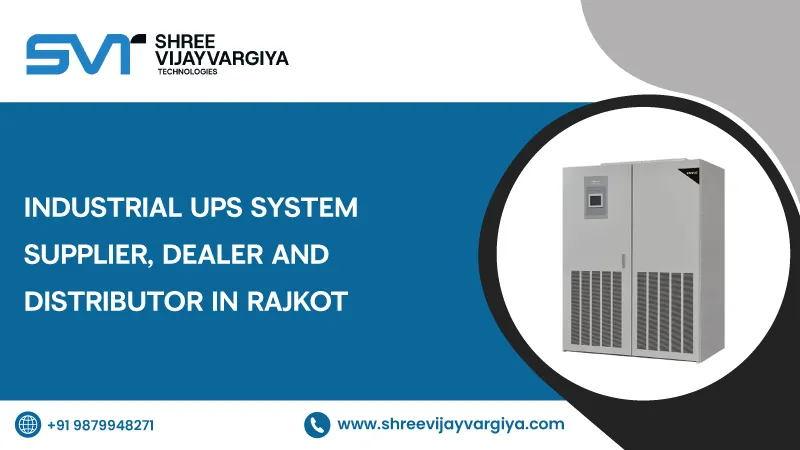
Surendranagar sits at the doorway between the Ahmedabad plains and the Saurashtra peninsula, and its industry reflects both. The twin towns of Surendranagar and Wadhwan host a GIDC estate full of small engineering and processing units. Thangadh, to the south-west, fires sanitaryware and ceramic products in kilns that run around the clock. Across the district, cotton gins and oil mills come alive after the harvest, and towards the Little Rann, salt pans near Kharaghoda and Patdi work through the dry months.
All of these businesses now lean on electronics that cannot tolerate a sudden loss of supply: kiln controllers, PLC panels, weighing systems, CNC controls and the office computers that manage orders and GST paperwork. This page is a practical guide for owners and maintenance heads in the district who want to protect those systems with an industrial UPS. It covers which loads to back up, how to choose between UPS types, how to size the kVA and batteries, and how to keep everything healthy in a hot, dusty district. It also explains how Shree Vijayvargiya Technologies Pvt. Ltd. (SVT) supports Surendranagar buyers from Ahmedabad and Morbi.
Industrial UPS Systems for Surendranagar District
A UPS that works perfectly in an air-conditioned office in Ahmedabad may struggle in a ginning shed in Limbdi or beside a kiln in Thangadh. Understanding the local setting comes first.
Where Surendranagar's Industry Sits
- Wadhwan GIDC and the Surendranagar town area: Small and medium engineering shops, fabrication units, plastics and packaging, and processing units supplying larger plants elsewhere in Gujarat.
- Thangadh: One of Gujarat's well-known centres for sanitaryware and ceramic products, with kilns, glazing lines, spray booths and slip preparation sections.
- The cotton belt: Surendranagar is a major cotton-growing district, and ginning and pressing factories, along with oil mills, are spread across the towns and highways.
- Kharaghoda and Patdi: Inland salt works on the edge of the Little Rann of Kutch, along with the processing, packing and transport activity that follows.
- Dhrangadhra and Limbdi: Smaller industrial and agro-processing towns where ginning, oil milling and workshop activity sit alongside trading businesses.
Loads That Earn a Place on the UPS
The easiest way to decide is to ask one question about each piece of equipment: what happens if it loses power for two seconds? If the answer is "it restarts by itself and nothing is lost", it does not need a UPS. If the answer involves a lost recipe, a tripped burner, a corrupted file or an unsafe stop, it does. In Surendranagar units, that usually points to:
- Kiln and burner management controls in Thangadh, including temperature controllers, flame supervision relays, PLCs and the recorders that track firing curves.
- PLC and HMI panels on ginning automation, bale presses, conveyors, oil expellers and packing machines.
- CNC and machine controls in Wadhwan workshops, where a voltage dip can stop a program and leave a part half-finished.
- Weighbridge indicators, load cell instruments and the attached PC at gins, oil mills and salt works, which record every truck that comes in or goes out.
- Servers, accounts PCs, CCTV recorders and internet routers in the office.
Fans, blowers, pug mills, ball mills, gin stands, compressors and brine pumps do not belong on the UPS. Their motors are large, they ride through restarts on their own, and adding them would multiply the UPS size and cost.
Heat, Dust and a Stop-Start Calendar
Surendranagar is among the hotter parts of Gujarat, and afternoon temperatures in summer regularly go above 40°C. Many units are housed in metal sheds that trap heat, and the electrical room is often just a corner of the shop floor. Heat affects a UPS in two ways: the electronics have to work harder to stay cool, and the batteries age much faster.
Dust adds to the problem. Cotton lint is light and finds its way into every fan grille. Ceramic body and glaze dust in Thangadh is fine and abrasive. Near the Rann, wind-blown dust and saline particles settle on everything. Once a UPS fan filter clogs, internal temperatures climb and alarms or shutdowns follow.
Then there is the calendar. Gins and oil mills run hard after the cotton and groundnut harvest and go quiet for months. Salt works are busiest in the dry season and stop during the monsoon. A UPS that is left without charge during the idle period may greet the next season with dead batteries, exactly when the plant needs it most.
Choosing the Topology for Each Load
Industrial buyers generally choose between two UPS types:
- Online double-conversion: The load is always fed from the inverter, which builds a clean sine wave from DC. Mains disturbances never reach the equipment and there is zero changeover time. This is the right choice for kiln controls, PLC panels, CNC controls and instrumentation.
- Line-interactive: The load is fed from mains through a voltage regulator, and the UPS shifts to battery when the mains goes out of range. It is cheaper and more efficient, and it is fine for office computers, routers and CCTV.
In a district where feeders are long and voltage can swing during peak agricultural demand, an online UPS gives the process electronics a stable supply regardless of what the mains is doing. For the office cabin, a line-interactive unit is usually enough.
A Simple Sizing Illustration
Suppose a small unit wants to protect one PLC panel drawing about 300 W, an HMI of 50 W, two temperature controller panels totalling 150 W, a PC of 250 W and a network switch of 50 W. That adds up to roughly 800 W. A UPS rated 1 kVA at 0.8 output power factor can deliver 800 W, but it would be running flat out. Choosing the next size up, such as 1.5 or 2 kVA, keeps the normal load well below the limit, leaves room for switch-on inrush and allows for a panel or two to be added later. The figures here are only an illustration; your own equipment ratings should always be used.
Backup time is decided separately. With a DG set and automatic changeover, the UPS needs to cover the time it takes the generator to start and settle, plus a reserve in case it fails to start first time. Without a DG, the battery should last long enough to finish the current cycle, bring the kiln or process to a safe state and save data. The supplier then works out the battery voltage, ampere-hour rating and number of batteries from the load and the backup time.
Getting More Years Out of UPS Batteries
Sealed maintenance-free lead-acid batteries are rated for their full design life at about 25°C. A commonly used rule of thumb says that their life is roughly halved for every 8 to 10°C of continuous operation above that level. In a Surendranagar shed that sits above 35°C for much of the summer, a battery bank can wear out long before the date printed on its label.
A few simple steps help:
- Keep the battery rack in the coolest, shaded part of the building, away from kilns, dryers and sun-facing walls.
- Use an exhaust fan or air conditioning in the UPS room where practical.
- Leave space between batteries so air can circulate.
- Keep the UPS charging during idle months, or recharge the bank at regular intervals.
- Note the installation date on the rack and plan replacement in advance.
Isolation Transformers and Earthing in Older Sheds
Many units in older estates have earthing that has not been tested in years. Welding sets, VFDs and heater controls also inject noise into the neutral. Electronic controls, particularly CNC systems and precision instruments, can react to a high neutral-to-earth voltage with random alarms or communication errors. An isolation transformer used with the UPS gives the protected load its own neutral-earth bond, separates it galvanically from the incoming supply and reduces common-mode noise. It is a useful addition in Wadhwan machine shops and Thangadh kiln control rooms, but it should go hand in hand with a properly maintained earth pit.
A Maintenance Calendar That Follows Production
The best time to service a UPS is when the plant can afford a short stop, not when the UPS has already failed. Tie the checks to your production cycle:
- Kiln shutdowns in Thangadh: clean fans and filters, check terminal tightness and review the UPS alarm log.
- Before the ginning season: carry out a battery discharge test and replace weak cells or blocks.
- Before the monsoon at salt works: inspect for corrosion on battery posts and cable lugs and clean off deposits.
- Throughout the year: keep a simple register of battery readings, alarms and any load added to the UPS.
Reaching SVT from Surendranagar
Surendranagar is closer to Ahmedabad than most of Saurashtra, and many customers here find it convenient to deal with SVT's head office at A-705, Titanium City Center, Prahlad Nagar, Ahmedabad 380015 (+91 9879948273). Units in the western part of the district, towards Dhrangadhra, may also find it handy to contact the Morbi office and warehouse at B-18, Parshwanath Complex-1, opposite Kuber Cinema, NH-8A, Trajpar, Morbi 363642 (+91 9879948267). Both offices work Monday to Saturday, 9 AM to 6 PM.
Send us your load list, panel photos or single-line diagram by phone or email. Our team will help with the choice of UPS type, kVA rating, battery bank and related items such as isolation transformers, and will give guidance on placement, cabling and battery care to your electrician or panel builder. Goods are dispatched from Ahmedabad or the Morbi warehouse to your site in Surendranagar, Wadhwan, Thangadh, Dhrangadhra, Limbdi, Patdi or elsewhere in the district. Other districts we cover are listed on our service areas page.
Industrial UPS Basics for Plant Teams
An industrial UPS system does two jobs. It keeps the load running without a break when the mains fails, and it supplies conditioned power while the mains is present. Industrial models are built for continuous duty, wider input voltage ranges, panel-type loads and, in larger ratings, three-phase input.
Why Control Electronics Are So Sensitive
PLCs, controllers and PCs run on low-voltage DC derived from the mains through switch-mode power supplies. Those supplies can ride through only a very short interruption. A longer dip makes the processor reset, and the plant then has to rebuild its state: re-home axes, restart sequences, re-check interlocks. In a kiln, a controller reset at the wrong moment can upset the firing curve and affect a whole batch. A UPS removes that risk by keeping the DC supplies fed without interruption.
Bypass, Monitoring and Alarms
Most industrial UPS units include a static bypass that transfers the load to mains if the inverter is overloaded or develops a fault, so the equipment is not left without power. Larger units add a manual maintenance bypass so the UPS can be worked on while the load stays on mains. Many models also offer dry contacts or communication ports, which can send UPS alarms to a PLC or SCADA system, or trigger an orderly shutdown of servers when the battery runs low. Ask for these features if your plant has a control room or a server that needs automatic shutdown.
UPS Ranges Available Through SVT
SVT supplies ProstarM UPS systems for a wide range of panel, instrumentation and office applications, and TMEIC industrial UPS systems for larger and more demanding three-phase loads. The choice depends on the load size, the backup time, the installation conditions and the budget. Our team will explain the options in plain language so you can decide what fits your unit.
Checklist Before You Order
- A list of the loads to be protected, with their rated power or current.
- Single-phase or three-phase supply at the point of installation.
- Required backup time, and whether a DG set with changeover is available.
- The room where the UPS and batteries will be placed, and its ventilation.
- The condition of the earthing and whether an isolation transformer is needed.
- Expected additions over the next few years.
Final Thoughts
From the kilns of Thangadh to the gins of Limbdi and the workshops of Wadhwan GIDC, Surendranagar's industry depends on control electronics that need clean, uninterrupted power. Heat, dust and seasonal working make UPS selection and upkeep more important here, not less. With the right topology, sensible sizing, a cool battery location and a maintenance routine tied to production, an industrial UPS will protect your processes for years. Shree Vijayvargiya Technologies Pvt. Ltd. is ready to help you plan that from its Ahmedabad and Morbi offices.
For an industrial UPS requirement in Surendranagar, call +91 9879948273 (Ahmedabad), +91 9879948267 (Morbi) or email sales2@shreevijayvargiya.com.
Key Takeaways
- Back up kiln and burner controls, PLC panels, CNC controls, weighbridge systems and office IT; leave motors and pumps off the UPS.
- Choose online UPS for process control and line-interactive for office equipment.
- Size the UPS with clear headroom and set backup time around DG changeover or safe shutdown.
- High temperatures shorten battery life sharply, so place batteries in the coolest available spot.
- Keep batteries charged during idle months and test them before each busy season.
- SVT serves Surendranagar from its Ahmedabad head office and its Morbi office and warehouse, with dispatch from either location.
Frequently Asked Questions
Summarize with AI: