

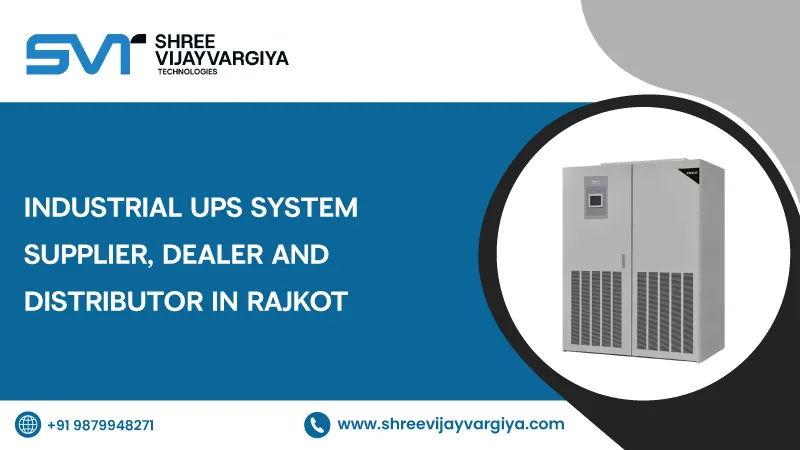
Saurashtra is not one industrial cluster but a string of very different ones. A brass turning shop in Jamnagar, a plastic reprocessing unit in Bhavnagar, a fish processing plant at Veraval and a groundnut oil mill in Gondal all buy electricity from the same state grid, yet each faces its own set of power problems. What they share is a growing dependence on electronics: PLCs that sequence the process, temperature controllers that hold a set point, PCs that print invoices and e-way bills, and instruments that log every batch.
This guide is for plant owners, maintenance engineers and purchase teams across the peninsula who are planning to buy an industrial UPS or replace an old one. It covers which equipment belongs on a UPS, the choice of topology, kVA, batteries and upkeep, and how Shree Vijayvargiya Technologies Pvt. Ltd. (SVT) supports the region from its Morbi office and warehouse and its Ahmedabad head office.
Industrial UPS Systems Across Saurashtra
Before choosing any equipment, it helps to look at how varied the region's industry is. The right UPS for a cold store on the coast is not the right UPS for a ginning factory inland, even when the kVA rating turns out to be similar.
A Region of Many Trades
- Jamnagar: The city is known across India for brass parts, with a large number of turning, threading and forging shops in areas such as Shankar Tekri and Dared. The refinery belt along the Jamnagar coast has also brought in fabrication, instrumentation and maintenance contractors who run their own workshops and testing setups.
- Bhavnagar: Plastic processing and reprocessing units, re-rolling mills and a wide supply chain linked to the Alang ship recycling yard. Extrusion lines, granulators and moulding machines all carry heater and temperature controls that react badly to supply disturbances.
- Junagadh, Porbandar and Veraval: Fishing harbours along this coast feed seafood processing, freezing and export units, along with ice plants and cold storages. Agro-based units around Junagadh add to the mix.
- Gondal and Amreli: Groundnut and cotton country. Oil mills, ginning and pressing factories and seed processing plants work hard after harvest and slow down for the rest of the year.
- Rajkot and Morbi: Rajkot is the region's engineering capital, with CNC machine shops, foundries and pump makers. Morbi is the ceramic tile and sanitaryware centre of the country and is also home to wall clock and allied units. SVT's own Saurashtra-side office and warehouse is in Morbi.
Which Equipment Should Sit on the UPS
A UPS is meant for the brains of a plant, not its muscles. Motors, heaters, compressors and furnace coils draw large currents and recover on their own once the supply returns. The electronics that tell them what to do are the ones that lose memory, trip on fault or need a slow restart. In Saurashtra plants the usual candidates for UPS backup are:
- PLC and control panels on extrusion lines, oil expellers, ginning automation, packing machines and conveyor systems, including the HMI and the 24 V DC power supply that feeds sensors and relays.
- Process instrumentation such as temperature controllers, pressure transmitters, flow meters, weighing indicators and data loggers.
- Kiln and burner controls in ceramic units and other thermal processes, where the flame safeguard and control circuit must stay alive so that the system can be shut down in a safe sequence.
- CNC controls on lathes and machining centres in Jamnagar and Rajkot, so that a short dip does not abort a part halfway through.
- Refrigeration controllers, temperature monitoring and gas leak detection panels in cold storages and seafood plants. The compressors themselves stay off the UPS, but the monitoring and safety electronics should not go blind during a changeover.
- Servers, billing PCs, CCTV recorders and network switches in the office and weighbridge cabin.
Coastal Air, Dust and Seasonal Loads
Saurashtra has a long coastline, and plants in Jamnagar, Porbandar, Veraval and Bhavnagar breathe humid, salt-laden air for much of the year. Salt deposits on circuit boards and terminals absorb moisture and slowly corrode copper tracks, connectors and battery posts. A UPS kept in an open shed near the sea will age far faster than the same unit in a closed, dry room. Where possible, keep the UPS and batteries in an enclosed electrical room, keep doors shut during the monsoon and inspect terminals for white or green deposits during routine checks.
Inland, the problem changes from salt to dust. Cotton lint in ginning factories, groundnut husk dust in oil mills, ceramic powder in Morbi and metal fines in brass shops all find their way into UPS cooling fans and heat sinks. Blocked airflow raises the internal temperature, and electronics that run hot fail sooner. Filters on the UPS room ventilation and a regular blow-out with dry air during shutdowns make a real difference.
The third factor is the seasonal pattern of work. Many agro units run long hours for a few months and stand idle for the rest. During peak season, local feeders carry heavy agricultural and industrial load, and voltage can sag at the tail end of long rural lines. During the off season, a UPS that is simply switched off at the mains will let its batteries self-discharge, and a battery that sits deeply discharged for months may not recover. Both phases need planning.
Online or Line-Interactive: Making the Call
A line-interactive UPS passes mains power through to the load most of the time, correcting moderate voltage swings with an automatic voltage regulator and switching to battery when the supply goes out of range. It is efficient and economical, and it suits office PCs, small network racks and billing counters.
An online double-conversion UPS turns incoming AC into DC and then rebuilds a fresh AC waveform from its inverter at all times. The load never sees the raw mains, so dips, surges, frequency drift and electrical noise are filtered out continuously, and there is no transfer time when the mains fails. For PLC panels, CNC controls, kiln controls and instrumentation in a plant with welding sets, induction heaters or large motors nearby, the online type is the sensible default. In short: line-interactive for the office, online for anything that controls the process.
Working Out kVA and Battery Backup
UPS ratings are given in kVA (apparent power) and kW (real power). To size a unit, list every load you intend to connect along with its rated wattage or current. Add them up, convert to kVA using the power factor stated in the UPS datasheet, and then add headroom. Many engineers prefer the normal running load to stay well below the full rating, often in the region of 70 to 80 per cent, leaving margin for switch-on inrush and future additions.
Backup time is a separate decision. If your plant has a DG set with an automatic changeover, the UPS only has to bridge the gap until the generator is up and stable, plus a margin in case the first start fails. If there is no DG, the backup should be long enough for operators to complete a controlled shutdown, save data and bring the process to a safe state. Battery capacity follows from the load in watts, the backup time and the DC bus voltage of the UPS. Asking for hours of backup on a large UPS quickly becomes expensive, so match the backup time to what the process genuinely needs.
Battery Life When the Room Runs Hot
Most industrial UPS systems use sealed maintenance-free lead-acid batteries. Their design life is quoted at around 25°C. Saurashtra summers are much warmer than that, and a battery rack placed in a tin shed or next to a kiln can run at well over 35°C for weeks. A widely used rule of thumb is that battery life roughly halves for every sustained rise of about 8 to 10°C above the rated temperature. In practice, a battery bank in a hot room may need replacement far earlier than its label suggests.
Keeping batteries in a shaded, ventilated or air-conditioned room is one of the cheapest ways to protect the investment. Keep the rack away from sun-facing walls and heat sources.
Where an Isolation Transformer Helps
In older industrial sheds, earthing is often weak and the neutral may carry noise from welding machines, drives and induction heaters. CNC builders, measuring instrument makers and some PLC vendors specify a low neutral-to-earth voltage, and a poor earth can cause random faults even with a good UPS. An isolation transformer creates a fresh, separately derived neutral and earth reference for the protected load, blocks a good part of common-mode noise and gives galvanic separation between the supply and the equipment. In Jamnagar brass shops, Bhavnagar extrusion units and Rajkot machine shops, adding an isolation transformer at the UPS output or input is often worth considering. It is not a substitute for a proper earth pit, so have the earthing tested as well.
Planning Maintenance Around the Season
Maintenance is easier when it is tied to the plant calendar rather than left until something fails. A practical routine for Saurashtra units looks like this:
- Before the busy season: run a controlled battery discharge test, clean fans and filters, tighten terminals and check the UPS event log for repeated alarms.
- During the season: keep an eye on the UPS display for overload warnings as extra machines are added, and avoid plugging unplanned loads into UPS sockets.
- During the off season: keep the UPS charging, or at least recharge the batteries at regular intervals, so they do not sit discharged for months.
- Every year: record battery voltages and internal condition where your test equipment allows, and plan replacement before the bank reaches the end of its useful life.
Coastal plants should add a visual check for corrosion on battery posts, lugs and busbars during the monsoon months.
How SVT Serves Saurashtra from Morbi and Ahmedabad
SVT's Saurashtra-side base is its office and warehouse at B-18, Parshwanath Complex-1, opposite Kuber Cinema, NH-8A, Trajpar, Morbi 363642, reachable on +91 9879948267. The head office is at A-705, Titanium City Center, Prahlad Nagar, Ahmedabad 380015, on +91 9879948273. Both offices are open Monday to Saturday, 9 AM to 6 PM.
Customers in Jamnagar, Bhavnagar, Junagadh, Porbandar, Veraval, Gondal, Amreli, Rajkot and Morbi can send their load list, panel details or a single-line diagram by phone or email. Our team helps with UPS type, kVA rating, battery configuration and accessories such as isolation transformers, and gives technical guidance on placement, cabling and battery care. Orders are dispatched from Ahmedabad or from the Morbi warehouse. Installation is usually handled by the customer's electrician or panel builder, and we can brief them on what to look out for. You can also see the other districts we cover on our service areas page.
Understanding Industrial UPS Technology
An industrial UPS is built for a harder life than an office UPS. It is designed for continuous duty, wider input voltage windows and, in larger ratings, three-phase supplies. Its job is to keep the connected equipment running without a break when the mains fails, and to give it cleaner power while the mains is present.
What Happens Inside an Online UPS
The rectifier converts incoming AC to DC and keeps the batteries charged, and the inverter turns that DC back into a regulated sine wave. When the mains fails, the battery simply takes over feeding the DC bus, so the output carries on without a gap. A static bypass transfers the load to mains if the inverter is overloaded or faulty, rather than dropping it.
Choosing Between UPS Ranges
SVT supplies more than one UPS range so that the choice can follow the application. The ProstarM UPS range includes UPS models that fit many control panel, instrumentation and office requirements in small and medium plants. For larger and more demanding three-phase loads, TMEIC industrial UPS systems are also available through SVT. The selection depends on the load, the backup time, the site conditions and the budget, and we will explain the trade-offs rather than push one brand.
Common Mistakes to Avoid
- Connecting motors, heaters or air conditioners to a UPS meant for control electronics, which overloads it and drains the battery quickly.
- Buying on kVA alone without checking output power factor, battery voltage and the charger capacity.
- Ignoring earthing and expecting the UPS alone to cure noise problems.
- Not recording when batteries were installed, so nobody knows when they are due for replacement.
Conclusion
Every corner of Saurashtra brings its own mix of challenges for power protection: salt air on the coast, dust inland, high summer temperatures everywhere and a work cycle that rises and falls with the harvest. A well-chosen industrial UPS keeps PLCs, instruments, kiln controls and data safe through all of it, provided it is sized honestly, placed sensibly and maintained on a schedule. Shree Vijayvargiya Technologies Pvt. Ltd. works with plants across the region from its Morbi office and warehouse and its Ahmedabad head office, helping customers pick the right UPS type, rating and battery bank for the job.
To discuss a UPS requirement for your Saurashtra plant, call +91 9879948267 (Morbi), +91 9879948273 (Ahmedabad) or email sales2@shreevijayvargiya.com.
Key Takeaways
- Put control electronics, instruments, kiln controls and IT equipment on the UPS, not motors and heaters.
- Online double-conversion UPS suits process control; line-interactive suits office loads.
- Size kVA with headroom and set backup time around your DG changeover or safe shutdown needs.
- Heat, coastal salt and dust shorten UPS and battery life, so the room matters as much as the rating.
- Seasonal plants should keep batteries charged during idle months and test them before the season starts.
- SVT supports Saurashtra customers from its Morbi office and warehouse and its Ahmedabad head office, with dispatch from either location.
Frequently Asked Questions
Summarize with AI: