


Key Takeaways
- Selecting the right sensor is crucial for reliable industrial automation and performance outcomes.
- Shree Vijayvargiya Technologies Pvt. Ltd. is a trusted Sensor Dealer in Gujarat for quality sensor solutions.
- Understanding different sensor types helps in making informed selections tailored to specific applications.
- Common sensor selection mistakes can lead to costly operational issues and delays in industrial automation projects.
- Choosing the right sensor is crucial for the performance of industrial automation systems.
Industrial automation has transformed modern manufacturing by improving productivity, consistency, and operational efficiency. At the center of every successful automation system lies a critical component: the sensor. Sensors act as the eyes and ears of industrial equipment, collecting valuable data and helping machines respond accurately to changing conditions. Selecting the right sensor is one of the most important decisions for any automation project because the performance of the entire system depends on the quality and suitability of the sensing technology used.
Whether you are designing a new automation setup or upgrading an existing production line, understanding how to choose the right sensor can help improve accuracy, reduce downtime, and support long-term operational goals. Shree Vijayvargiya Technologies Pvt. Ltd. offers a wide range of industrial sensors designed to meet the diverse requirements of manufacturing, packaging, automotive, food processing, pharmaceuticals, logistics, and many other industries.
Why Sensor Selection Deserves More Attention Than It Usually Gets
There is a tendency in automation projects to focus most of the engineering attention on the controller, the drives, and the mechanical design — and to treat the sensor selection as a relatively minor detail to be finalized later. This approach leads to problems more often than it should.
Sensors sit at the interface between the real physical world and the control system. Everything that happens inside the PLC or controller depends on the quality and accuracy of the signals coming from the sensors. A sensor that produces false outputs because it was not specified correctly for the environmental conditions will generate faults that look like control system problems — and can take significant time to diagnose correctly. A sensor with the wrong output type will require additional interface circuitry that was not planned for. A sensor with inadequate response speed on a high-speed line will miss detections and create random errors that are almost impossible to trace reliably.
Getting the sensor selection right at the design stage costs nothing extra and saves a great deal of pain during commissioning and operation. As a specialist Sensor Distributor in Gujarat, Shree Vijayvargiya Technologies Pvt. Ltd. frequently helps customers resolve problems that trace back to sensor specifications that were not properly matched to the application — and equally, works with design engineers upfront to select sensors that perform reliably from day one.
The Major Sensor Types and What They Do
Industrial automation draws on a wide range of sensor technologies, each suited to detecting or measuring different physical phenomena. Understanding the primary types and their operating principles is the foundation of good sensor selection.
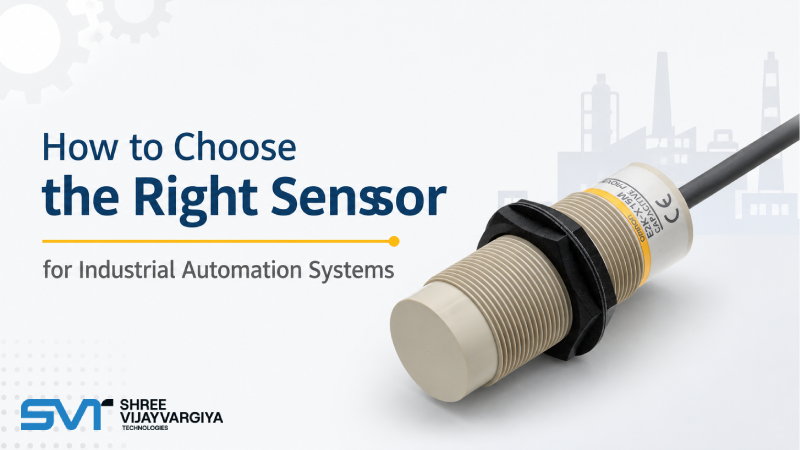
Without making physical contact, proximity sensors determine if an object is there or not. They are one of the most widely used sensor types in factory automation, used for position detection, part counting, end-of-travel detection, and object detection on conveyors and assembly lines. There are two main variants: inductive proximity sensors, which detect metallic objects by sensing changes in an electromagnetic field, and capacitive proximity sensors, which can detect both metallic and non-metallic objects — including liquids, plastics, and powders — by sensing changes in capacitance. Choosing between them depends on the target material. For metal detection, inductive types are generally more reliable and less susceptible to environmental interference. For non-metal detection, capacitive types are the appropriate choice.
Photoelectric Sensors (Optical Sensors)use light — typically infrared, visible red, or laser — to detect objects or measure distances. They operate over longer ranges than proximity sensors and can detect objects regardless of material type. The three main configurations are through beam (separate emitter and receiver, very reliable, suitable for long ranges), retroreflective (emitter and receiver in one housing, beam reflected back from a reflector), and diffuse (emitter and receiver in one housing, beam reflected from the target object itself). Each configuration has its strengths and limitations in terms of range, target type, and environmental conditions. Shree Vijayvargiya Technologies Pvt. Ltd. supplies Omron photoelectric sensors across a range of configurations, and the technical team can advise on the right configuration for specific applications.
Temperature Sensors measure thermal conditions at a point in a process or on a machine surface. In industrial automation, the most common types are thermocouples (suitable for wide temperature ranges and high-temperature environments), RTDs (Resistance Temperature Detectors — more accurate and stable than thermocouples, preferred for precision measurement), and non-contact infrared sensors (for measuring surface temperatures of moving objects or in situations where contact is not practical). Selecting the right temperature sensor involves matching the sensor's measuring range and accuracy to the process requirements and choosing a construction that will withstand the physical and chemical environment.
Pressure Sensors measure fluid or gas pressure in pipes, tanks, and systems. In automation contexts, they are used for monitoring hydraulic and pneumatic systems, detecting blockages or leaks, confirming process conditions, and providing feedback for pressure control loops. Key selection parameters include the pressure range, the media compatibility (the sensor materials must be chemically compatible with the fluid or gas being measured), the output type, and the accuracy required.
Motion and Speed Sensors detect movement, rotation, or velocity. Encoders — both incremental and absolute — are widely used for measuring shaft position and speed in motor-driven systems, conveyor speed control, and servo positioning. Vibration sensors detect abnormal mechanical vibration that indicates developing faults in rotating equipment. Tilt and inclination sensors provide orientation data for mobile machinery and systems that operate at varying angles.
Force and Torque Sensors measure the mechanical forces or torques applied in assembly, pressing, clamping, and testing applications. They are increasingly important as manufacturing moves toward more intelligent, force-aware assembly processes.
Shock and Vibration Sensors detect impacts and vibration levels, used both for process monitoring and for machine health monitoring — feeding data to predictive maintenance systems that flag developing mechanical problems before they cause failures.
This breadth of sensor types is exactly why working with a knowledgeable Sensor Dealer in Gujarat who stocks and understands the full range matters. The right sensor for a conveyor counting application is a fundamentally different product from the right sensor for a temperature monitoring loop or a hydraulic pressure feedback system.
Six Critical Factors That Should Drive Every Sensor Selection
Beyond understanding the sensor types, experienced automation engineers follow a structured selection process that considers the application requirements systematically. Here are the six factors that consistently make the biggest difference in sensor selection outcomes.
Detection Target and Physical Properties — The nature of the target object or measurand is the starting point for every sensor selection. What material is the object? What are its size and surface characteristics? Is it moving or stationary? For proximity sensors, target material determines whether inductive or capacitive is appropriate. For photoelectric sensors, target reflectivity and surface finish affect the choice of configuration. Getting this wrong at the start leads to fundamental mismatch between the sensor and the application.
Detection Range and Sensing Distance — The distance between the sensor and the target at the point of detection must fall within the sensor's specified operating range — with margin. A sensor operating at the very edge of its rated range is more susceptible to false outputs from minor variations in target position, surface condition, or environmental factors. As a general rule, operate sensors within 70-80% of their rated range for reliable, stable performance.
Environmental Conditions — This is where sensor selections most commonly go wrong. The physical environment in which the sensor will operate must be evaluated honestly and completely. Temperature extremes, humidity, dust, oil mist, chemical exposure, mechanical vibration, and electrical noise are all common in industrial environments, and each can affect sensor performance and longevity. IP (Ingress Protection) rating is the primary indicator of resistance to dust and water. For harsh environments, sensors with IP67 or IP68 ratings provide the right level of protection. Chemical resistance must be verified for the specific substances present. Omron sensors supplied by Shree Vijayvargiya Technologies Pvt. Ltd. cover a wide range of environmental ratings, making it straightforward to match the sensor's construction to the operating conditions.
Output Type and Interface Compatibility — The sensor's output signal must be compatible with the input module it will connect to in the control system. Common sensor output types include NPN (sinking) and PNP (sourcing) transistor outputs for discrete sensors, and voltage (0-10V) or current (4-20mA) analogue outputs for sensors measuring continuous variables. Mismatching output and input types is a common commissioning error that can usually be avoided by confirming the PLC input module specifications before finalizing sensor selection.
Response Speed— For high-speed detection applications — counting parts on a fast conveyor, detecting objects on a high-speed packaging line, monitoring shaft position at high RPM — the sensor's response time must be fast enough to reliably detect every event. A sensor that is slightly too slow will miss occasional detections, producing random errors that are difficult to diagnose. The required response time is calculated from the target speed and the minimum detection time required.
Mounting and Mechanical Integration — The sensor must physically fit the mounting location available in the machine design, with appropriate mechanical connections and cable routing. Flush-mountable proximity sensors are needed where the sensor must be recessed into a metal bracket without the surrounding metal affecting the sensing field. Specific connector types, cable lengths, and housing orientations matter in practice and should be confirmed before ordering.
Omron Sensors — The Product Range Behind the Selection
Shree Vijayvargiya Technologies Pvt. Ltd. is an authorized Sensor Distributor in Gujarat for Omron sensors — a range that has been developed specifically to meet the demands of industrial automation across the full spectrum of sensing requirements.
Omron's sensor range covers proximity sensors (inductive and capacitive), photoelectric sensors (through-beam, retroreflective, diffuse, and laser types), temperature sensors, pressure sensors, rotary encoders, vision sensors, fibre optic sensors, safety sensors, and more. The range is built into industrial specifications, with robust housing, reliable switching outputs, and the kind of consistent performance across operating life that production environments demand.
What sets Omron sensors apart technically is their combination of sensing performance — range, accuracy, repeatability — with the durability to maintain that performance in real industrial conditions over the long term. An Omron photoelectric sensor installed on a conveyor line in a dusty environment should still be producing clean, reliable outputs two years later. This is the standard that industry-grade sensors are held to, and it is the standard that Omron consistently meets.
Common Sensor Selection Mistakes That Cost Manufacturers Dearly
Even experienced engineers occasionally make sensor selection errors. The costliest ones follow recognizable patterns.
Selecting a sensor based on catalogue specification alone, without visiting or analyzing the actual installation environment, leads to products that work in the lab and struggle in the field. Environmental conditions are often harsher in practice than they appear on paper — oil mist reaches further, temperature fluctuations are wider, and vibration levels are higher than initial estimates suggest.
Ignoring the difference between rated sensing distance and actual reliable sensing distance is another frequent error. A sensor rated for 10mm sensing distance should not be installed at 9mm in a production application — minor variations in target position, bracket alignment, or component wear will push the target in and out of reliable detection range, creating intermittent faults.Ignoring output type compatibility prior to purchase results in additional interface components and wiring rework during commissioning—delays and expenses that were completely preventable. Confirming PLC input module compatibility as part of the sensor selection process adds minutes to the design review and saves hours at installation.
Why Choose Us
Shree Vijayvargiya Technologies Pvt. Ltd. has been serving Gujarat's industrial automation sector since 2012 from its base in Ahmedabad, building a strong reputation as a trusted Sensor Dealer in Gujarat by consistently combining high-quality products with genuine application expertise. Our sensor range — anchored by Omron's comprehensive and technically proven product line — covers proximity sensors, photoelectric sensors, temperature sensors, pressure sensors, encoders, vibration sensors, and more, giving customers a single source for virtually every sensing requirement in industrial automation. More than just supplying products, our technical team works with customers through the selection process — understanding the application, the environment, the control system interface, and the performance requirements — to recommend sensors that will work reliably in practice, not just on paper. From Ahmedabad, Rajkot, Surendranagar, and Kutch to Saurashtra and across Gujarat, we supply and support industrial sensors for manufacturers who need a partner they can trust to get the specification right the first time.
Conclusion
Sensor selection is one of the most consequential technical decisions in any automation project — and one that deserves the same careful attention as the controller, the drives, and the mechanical design. The right sensor, correctly specified for the target, the environment, and the control system interface, is the difference between an automation system that runs reliably and one that generates unexplained faults and constant maintenance attention. With a comprehensive range of Omron industrial sensors and a technical team that understands how to match product to application, Shree Vijayvargiya Technologies Pvt. Ltd. is the Sensor Dealer in Gujarat that manufacturers across the state turn to when the specification has to be right the first time.
Need expert help selecting the right sensor for your industrial automation system? Talk to the specialists at Shree Vijayvargiya Technologies Pvt. Ltd. and get the right solution to match your exact application requirements.
Call us: +91 9879948271 Email Us: sales2@shreevijayvargiya.com.